

What Is The Mechanism Through Which Npdes Can Ensure Clean Water
EPA works with its federal, land and tribal regulatory partners to monitor and ensure compliance with clean water laws and regulations in social club to protect human health and the environment. The Clean Water Act is the master federal law governing water pollution.
On this folio:
- Wastewater Management
- Municipal Wastewater Overflows and Stormwater Direction
- Pretreatment
- Stormwater
- Discharges from Full-bodied Animal Feeding Operations (CAFOs)
- Biosolids
- CWA Section 404
- Oil Spills and Spill Prevention
Wastewater Management
The CWA's National Pollutant Belch Elimination System (NPDES) Programme regulates signal sources that discharge pollutants into waters of the Usa. Compliance monitoring under the NPDES Program encompasses a range of techniques, from Discharge Monitoring Report reviews, to on-site compliance evaluation as well as providing help to enhance compliance with NPDES permits. The objective is to address the most significant bug and to promote compliance among the regulated community. The NPDES Compliance Inspection Manual provides information on how compliance inspections are conducted.
Compliance monitoring under the NPDES Plan takes place largely at the state level. EPA has authorized all but four states to implement their own NDPES programs to control water pollution. EPA oversees authorized land programs and has direct implementation responsibilities for the unauthorized states (ID, NM, MA and NH) equally well every bit federal facilities and in Indian Land.
The CWA NPDES Compliance Monitoring Strategy provides implementation guidance to EPA regions and authorized states by describing EPA'southward inspection frequency goals.
NPDES permits are issued to whatever facility that discharges directly into waters of the United states. Regulated entities include industrial and municipal facilities and include the following types of discharges:
Municipal Wastewater Overflows and Stormwater Management
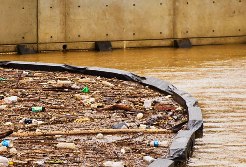
Boom captures litter and other droppings carried by stormwater
Overflows of raw sewage and inadequately controlled stormwater discharges from municipal sewer systems can end up in waterways or fill-in into city streets or basements of homes threatening h2o quality, human health and the environment. EPA conducts inspections of Publicly Owned Handling Works (POTWs) including combined sewer systems and sanitary sewer systems.
EPA inspections for combined sewer systems involve:
- reviewing the NPDES permit and any enforcement orders
- verifying the permittee is in compliance with the permit
- verifying that the permittee is preventing combined sewer overflows (CSOs) during dry out weather
- reviewing compliance with the nine minimum CSO controls
- verifying that the permittee is adhering to a schedule in the long term control plan
- implementing a monitoring program
- eliminating overflows in sensitive areas
- minimizing industrial discharges during overflow events
EPA inspections for sanitary sewer systems involve:
- reviewing the NPDES allow and whatever enforcement orders
- verifying that the permittee is in compliance with the NPDES standard permit atmospheric condition to mitigate and institute proper operation and maintenance
- determining if there are any unpermitted discharges such as sanitary sewer overflows (SSOs)
Pretreatment
EPA implements the National Pretreatment Program to ensure that industrial and commercial facilities (e.g., dry cleaners, gas stations, and food service establishments) discharging to publicly-endemic treatment works (POTWs) do non belch pollutants that pass through POTWs untreated or interfere with a POTW's wastewater treatment processes and sewage sludge use or disposal. Pollutants including metals, oil and grease, and other pollutants, may interfere with the operation of POTWs leading to the discharge of untreated or inadequately treated pollutants into waterways. As office of the National Pretreatment Program, EPA may approve states and local POTWs to implement an canonical pretreatment program.
EPA conducts both inspections and audits of POTWs to assess the effectiveness of their pretreatment program. Pretreatment audits are designed as a comprehensive review of all facets of the POTW's pretreatment program. The inspect addresses all of the items covered in a pretreatment inspection, but in greater particular.
Pretreatment inspections involve:
- reviewing the canonical programme, annual reports, NPDES compliance status, previous inspection reports, pretreatment files, denizen complaints
- interviewing officials knowledgeable of the program
- inspecting various industrial user operations, if advisable
Additional data on the National Pretreatment Plan.
Stormwater
Stormwater pollution occurs when debris, chemicals, sediment or other pollutants are washed into storm drains and flows into h2o bodies. The CWA, and its implementing regulations, requires that certain industrial facilities, structure sites, and municipal separate tempest sewer systems (MS4) obtain coverage for their stormwater discharges under an NPDES let, develop a Stormwater Pollution Prevention Plan (SWPPP) or Stormwater Management Plan (SWMP) and put measures in place to prevent discharges of pollutants in stormwater runoff.
EPA conducts inspections of three types of facility operations subject to the storm water regulations:
- construction sites
- industrial sites
- municipal separate tempest sewer systems (MS4)
These inspections involve:
- reviewing the storm water let, the SWPPP or SWMP, and stormwater records and reports
- interviewing personnel knowledgeable of the SWPPP or SWMP and facility operations
- reviewing and observing all-time management practices and control measures in place, and
- sampling stormwater discharges if appropriate.
For MS4 operators, EPA as well conducts audits designed to provide a comprehensive review of main facets of the stormwater direction programme, namely:
- control of illicit discharges,
- discharges from structure sites (active and post structure),
- discharges from industrial facilities (typically only for the largest MS4s),
- implementation of pollution prevention/good housekeeping practices, and
- interest of and outreach to the public.
Discharges from Concentrated Animal Feeding Operations (CAFOs)
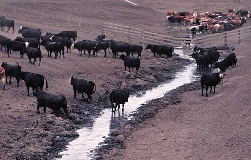
Beefiness cattle functioning
Under the Clean H2o Human action, Concentrated Animal Feeding Operations (CAFOs) are defined as betoken source dischargers.
EPA's revised NPDES CAFO regulation prohibits discharges from a CAFO to waters of the U.Due south. without an NPDES permit. The NPDES regulation describes which operations authorize as CAFOs and sets forth the bones requirements that will be included in all CAFOs' permits.
For data to help determine if your operation is a CAFO and if you require a NPDES let, EPA has prepared a NPDES Permit Writers' Transmission for Concentrated Animal Feeding Operations.
EPA and state permitting regime utilise several approaches to monitor compliance with environmental regulations.
- Inspections - EPA and state permitting authorities may periodically audit facilities field of study to these regulations. Inspections may be in response to a citizen complaint or tip, a outcome of a random choice, or targeting based on a state's targeting method. EPA and land permitting government conduct two main types of inspections at CAFOs:
- Inspections that help to decide whether a facility is a CAFO and if information technology has discharged or is discharging pollutants to a water of the U.S. without a permit.
- Inspections to determine whether a permitted CAFO is in compliance with its NPDES permit.
- Permits, Records, and Reports - For permitted CAFOs, the permitting authority will monitor all information submitted, including the annual report and the food management plan.
- Self-inspect and self-disclosure - Permittees are responsible for ensuring that a CAFO is e'er in compliance with the conditions in the NPDES permit. EPA encourages the use of its Audit Policy or Modest Business organisation Policy if a facility self-discovers it is in non-compliance.
EPA has put together a series of answers to unremarkably asked questions to assistance livestock and poultry performance owners and operators understand what to expect from EPA National Pollutant Discharge Elimination System (NPDES) inspections.
Biosolids
When sewage sludge from municipal wastewater handling works is properly treated and candy, it becomes biosolids that can be applied as fertilizer, recycled or tending.
EPA conducts inspections of Publicly Owned Treatment Works (POTW) and other industrial facilities that generate, store, transport and dispose of biosolids. EPA inspections involve:
- reviewing the NPDES permit
- reviewing sludge self-monitoring records and reports
- interviewing facility personnel knowledgeable of the facility
- inspecting the sludge treatment and storage units
- sampling sludge
- reviewing how samples are collected and analyzed by the laboratory
CWA Department 404
Section 404 of the CWA regulates the placement of dredged or make full material into wetlands, lakes, streams rivers, estuaries and certain other types of waters. The goal of Section 404 is to avert and minimize losses to wetlands and other waters and to compensate for unavoidable loss through mitigation and restoration. Section 404 is jointly implemented past EPA and the U.S. Ground forces Corps of Engineers (Corps). The Corps issues Section 404 permits and monitors compliance with the issued permits.
Both the Corps and EPA are responsible for on-site investigations and enforcement of unpermitted discharges under CWA Section 404. The joint implementation of the Section 404 enforcement programme is outlined in a 1989 Memorandum of Agreement (MOA) between the agencies.
TheSection 404 Permitting spider web folio contains more detailed information.
Oil Spills and Spill Prevention
The CWA prohibits the discharge of oil or hazardous substances to waters of the U.South. or their adjoining shorelines in quantities that may be harmful to the public health or welfare or the environment. EPA Oil Pollution Prevention regulations farther crave owners and operators of non-transportation-related oil facilities to make and implement plans to preclude oil discharges. EPA regional personnel periodically behave inspections which may be either appear, or unannounced, to ensure compliance with these regulations. Facilities inspected are randomly chosen or:
- based on risk factors such as facility proximity to drinking water intakes or environmentally sensitive areas, or the age of facility infrastructure (tanks, pipe, etc.)
- as a follow up to an oil spill, or
- based on denizen complaints or tips
During inspections, EPA inspectors generally:
- request and review the Spill Prevention Control and Countermeasures (SPCC) Plan
- interview facility personnel and comport a walk-through inspection of the facility to ensure the facility is implementing its SPCC Plan
- interview personnel and conduct a walk-through inspection of the facility to ensure that the facility is implementing its Facility Response Programme (FRP), if applicable; and/or
- conduct a government-initiated unannounced exercise at FRP facilities to ensure implementation of the Plan
EPA guidance on the SPCC program:
- SPCC Guidance for Regional Inspectors
- Facility Response Program Rule

Source: https://www.epa.gov/compliance/clean-water-act-cwa-compliance-monitoring
Posted by: marshallscon1994.blogspot.com
0 Response to "What Is The Mechanism Through Which Npdes Can Ensure Clean Water"
Post a Comment