

How To Make Clean A Sporter Ak-47
| Type 56 | |
|---|---|
 The Blazon 56 with a folded spike bayonet and milled receiver | |
| Type | Assault rifle |
| Identify of origin | China |
| Service history | |
| In service | 1956–present |
| Used by | Meet Users |
| Wars | Vietnam War Laotian Civil State of war Sino-Indian War Rhodesian Bush War Insurgency in Jammu and Kashmir Cambodian Civil War Sino-Soviet Border War Guatemalan Ceremonious State of war Bangladesh Liberation War Cambodian–Vietnamese War Sino-Vietnamese War Salvadoran Civil War Communist insurgency in Thailand Soviet–Afghan War Nicaraguan Revolution Iran–Iraq State of war[ane] Sri Lankan Civil War Lord's Resistance Army insurgency Somali Civil War[two] Tuareg rebellion (1990–1995)[3] Persian Gulf State of war[1] Baren Township conflict Croatian War of Independence Bosnian War Nepalese Civil War Burundian Ceremonious War Kosovo War Liberian Civil Wars 2001 Afghanistan State of war Iraq War Mexican Drug War Insurgency in Khyber Pakhtunkhwa Cambodian–Thai border dispute Kivu Conflict[4] War in Darfur 2011 Libyan Civil War Syrian Civil War 2011 Iraqi Insurgency Northern Mali conflict Boko Haram insurgency South Sudanese Civil War Central African Ceremonious War (2012–present) Iraqi Civil War (2014–2017)[five] |
| Product history | |
| Designed | 1956 |
| Produced | 1956–present |
| No. congenital | x,000,000+[6] |
| Variants | Type 56 Type 56-1 Blazon 56-2 |
| Specifications | |
| Mass | Type 56: 3.8 kg (8.38 lb) Type 56-1: 3.7 kg (eight.sixteen lb) Blazon 56-two/56-4: 3.9 kg (8.threescore lb) QBZ-56C: 2.85 kg (6.28 lb) |
| Length | Type 56: 882 mm (34.7 in) Type 56-ane/56-ii: 874 mm (34.four in) w/ stock extended,654 mm (25.seven in) w/ stock folded. QBZ-56C: 764 mm (30.1 in) west/ stock extended,557 mm (21.9 in) west/ stock folded. |
| Barrel length | Type 56, Type 56-I, Type 56-II: 414 mm (16.3 in) QBZ-56C: 280 mm (11.0 in) |
| | |
| Cartridge | Type 56 variants -7.62×39mm Blazon 84S – 5.56×45mm |
| Caliber | 7.62mm |
| Action | Gas-operated, rotating commodities |
| Charge per unit of burn | 650 rounds/min[vii] |
| Cage velocity | Type 56, Type 56-I, Blazon 56-2: 735 m/south (2,411 ft/s) QBZ-56C: 665 m/s (2182 ft/south) |
| Constructive firing range | 100–800 m sight adjustments. Constructive range 300–400 meters |
| Feed arrangement | 20, 30, or twoscore-round detachable box magazine |
| Sights | Adaptable Iron sights |
The Type 56 (Chinese: 56式突击步枪; literally; "Assault Rifle, Model of 1956") besides known equally the AK-56,[eight] is a Chinese 7.62×39mm rifle. It is a variant of the Soviet-designed AK-47 (specifically Blazon iii) and AKM rifles.[9] The Type 56 rifle was designated by the Chinese military machine as "Type 1956 Sub-Machinegun", because the Type 56 took the role of SMG rather than infantry service rifle in the PLA in the rifle'southward early service years.[10] Product started in 1956 at Country Manufactory 66 merely was somewhen handed over to Norinco and PolyTech, who proceed to manufacture the burglarize primarily for consign.
Service history [edit]
During the Common cold War menstruation, the Blazon-56 was exported to many countries and guerrilla forces throughout the globe. Many of these rifles institute their way to battlefields in Africa, Southeast Asia, and the Heart East and were used alongside other Kalashnikov design weapons from both the Soviet Wedlock every bit well the Warsaw Pact nations of Eastern Europe.
Chinese support for the Democratic Republic of Vietnam before the mid-1960s meant that the Type-56 was often encountered past American soldiers in the hands of either Vietcong guerrillas or PAVN soldiers during the Vietnam state of war. The Blazon-56 was discovered far more than oft than the original Russian-fabricated AK-47s or AKMs.[11]
When relations between Mainland china and North Vietnam crumbled in the 1970s and the Sino-Vietnamese War began, the Vietnamese government still possessed vast quantities of Type-56 rifles in its inventory. The People's Liberation Army still used the Type 56 every bit its standard weapon during this time as well. Thus, Chinese and Vietnamese forces fought each other using the aforementioned rifle.

The Blazon 56 was used extensively by Iranian forces during the Iran–Republic of iraq State of war of the 1980s, with Iran purchasing large quantities of weapons from China for its military machine. During the state of war, Republic of iraq also purchased a small quantity, despite them existence a major recipient of Soviet weapons and aid during the conflict. This was done in conjunction with their purchasing of a large number of AKMs from Eastern Europe.[1] Consequently, the Islamic republic of iran–Iraq War became another disharmonize in which both sides utilized the Blazon 56.
Since the finish of the Cold State of war, the Type-56 has been used in many conflicts by various military machine forces. During the Croatian War of Independence and the Yugoslav Wars, it was used by the armed forces of Croatia. During the late 1990s, the Kosovo Liberation Army in Kosovo were as well major users of the Blazon 56, with the vast majority of the weapons originating from People's Socialist Republic of Albania, which received Chinese support during much of the Cold War.
In the Great britain and The states, the Blazon-56 and its derivatives are frequently used in the filming of movies and boob tube shows, standing in for Russian-made AK-47s due to their rarity amongst Kalashnikov style weapons. Type-56s are oftentimes visually modified to resemble other AK variants. In add-on, versions of the Type-56 that have had their select fire ability removed (referred to as "sporter" rifles) are as well available for civilian buying in most parts of the United States.
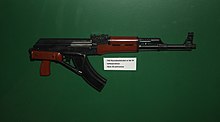
A Blazon 56-2 rifle with stock folded.
In the mid-1980s, Sri Lanka began to replace their British L1A1 Self-Loading Rifle (SLR) and German language HK G3s with the Blazon 56-ii. Currently, the side-folding stock variant (Type 56-2) issued equally the standard primary firearm.
The Type 81, Type 95 and Type 03 replaced the Type 56 in PLA front line service, only the Type 56 remains in use with reserve and militia units. Type 56s are still in production by Norinco for export customers.
During the Soviet–Afghan War in the 1980s, many Chinese Type 56 rifles were supplied to Afghan Mujahideen guerrillas to fight Soviet forces. The rifles were supplied past China, Pakistan and the US who obtained them from 3rd party artillery dealers.[12] There is photographic evidence from Soviet/Russian sources where captured Chinese Type 56 rifles were utilized by Soviet Regular army soldiers in Afghanistan in lieu with their standard-outcome Soviet AKM and AK-74 rifles.

Use of the Type 56 in Afghanistan likewise continued well into the early on 21st century as the standard rifle of the Taliban such as when Taliban forces seized control of Kabul in 1996 (a majority of the Chinese small artillery used by the Taliban were provided by Pakistan).[11]
Since the overthrow of the Taliban by U.S.-led Coalition forces in late 2001, the Type-56 assault rifle has been utilized by the Afghan National Army, serving alongside many other AK-47 and AKM variant rifles.
The Type-56 has been regularly seen in the hands of militants from the Izz advertising-Din al-Qassam Brigades, the armed wing of Hamas in the Palestinian territories.
The Type-56 has been used by the Janjaweed in the Darfur region of Sudan with pictures and news footage showing members of the Janjaweed conveying the rifles (most of them provided by the Sudanese authorities).
In 1987, Michael Ryan used a legally owned Type-56 rifle, and two other firearms, in the Hungerford massacre in the United Kingdom, in which he shot 32 people, 17 of whom died. The attack led to the passage of Firearms (Amendment) Human activity 1988, which bans ownership of semi-automatic centre-fire rifles and restricts the use of shotguns.[13]
In the Us, a Type-56 rifle, purchased in Oregon under a false proper noun,[14] was used in the 1989 Stockton schoolyard shooting in which Patrick Purdy fired over 100 rounds to shoot i teacher and 34 children, killing v. The shooting led to the passage of California's Roberti-Roos Assault Weapons Command Human action of 1989.[15] A Type 56, along with a Type 56 Southward-1, were used by Larry Phillips, Jr. and Emil Mătăsăreanu during the 1997 North Hollywood shootout.[sixteen]
In the ongoing Syrian Ceremonious War, Type-56 assault rifles are typically seen in the hands of Free Syrian Army forces.
Compared to AK-47 and AKM [edit]
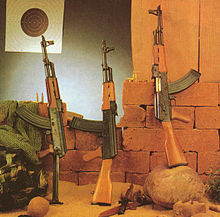
Blazon 56S-i (left), Type-84S (center), and Type-56S (right). Note that the Type 56 rifles in this image have been fitted with the distinctive slant compensator of the AKM, a feature non establish on the original Type 56
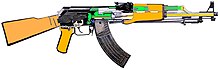
The gas-operated machinery of a Type 56 rifle.
Originally, the Type-56 was a direct copy of the AK-47'south concluding iteration, the Type three AK-47, and featured a milled receiver, Starting in the mid-1960s, the guns were manufactured with stamped receivers much like the Soviet AKM. Visually, well-nigh versions of the Blazon 56 are distinguished from the AK-47 and AKM by the fully enclosed hooded front sight (all other AK pattern rifles, including those made in Russian federation, have a partially open front sight). Many versions also feature a folding bayonet attached to the barrel just aft of the muzzle. There are three unlike types of bayonets made for Type 56 rifles. The first Type-56s were near-identical copies of the Soviet milled AK-47. There is some speculation[ by whom? ] that the Chinese had to reverse engineer a copy of the AKM with the stamped receiver as they were not given a licence to produce the AKM and RPK by the Soviets considering of failing relations subsequently the Sino-Soviet split.
- The Type 56 has a 1.6mm stamped receiver (like the RPK, although it lacks the reinforced trunnion of the RPK) versus the 1mm stamping of the AKM. Also uses a unlike riveting pattern that is like to the RPK. Certain versions of the 56S/MAK-90 have a milled receiver.
- The butt on the Type 56 is like to the AK-47 and heavier than that of the AKM though is pinned in similar the AKM and dissimilar the AK-47. Military issued versions of the Type-56 likewise lack the threaded muzzle establish on the AK-47 and AKM, this means they cannot utilise an AKM compensator or blank-firing device. Commercial versions of the Type 56 may or may not have a threaded cage.
- The front sights are fully enclosed with a hood, compared to the AKM and AK-47 which have partially opened "ears". The front sight base has a shape similar to the AK-47 and may also have a SKS way folding spike bayonet (nicknamed the "grunter sticker") as opposed to the lug for detachable knife bayonets on the AK-47 and AKM. At that place are 3 dissimilar types of fasten bayonets made for the Type-56 and the Type-56 attack rifle is the simply AK variant that utilizes a spike bayonet. Certain versions of the Type 56-II support standard AK-47 and AKM bayonets.
- Has the double hook disconnector of the AK-47 rather than the unmarried hook disconnector of the AKM. Every bit a result it also lacks the hammer release delay device of the AKM (a.k.a. the "Rate Reducer"). The lack of hammer retarder is perhaps due to a preference of a slightly higher rate of fire, and simplicity. And did not accept annihilation to do with thickness of the receiver, as the RPK included the hammer retarder also.
- Has "in the white" bolt carrier, while the AKM bolt carrier is blued. Also lacks the various lightening cuts, though has a flat firing pin. Many civilian/export versions have a firing pin spring to prevent possible slamfires when used with softer commercial primers as opposed to the original free floating type. Some were added by importers rather than being a factory equipped part.
- Has the flat/smooth handguards of the AK-47, with a storage slit underneath on versions equipped with the spike bayonet. Uniquely, it lacks vent cuts on the upper gas tube heatguard. Also retains a metallic ferrule that sits betwixt the lower handguard and the forepart of the receiver that the AK-47 had.
- The pistol grip is the same kind as the AK-47 being fabricated out of forest with a metal ferrule betwixt information technology and the receiver instead of the later one piece bakelite like the AKM. The Type 56-II uses the AKM fashion with slightly unlike shape.
- The trigger guard is held in identify with merely iii rivets (1 on each side and one beneath the pistol grip) where every bit the AK-47 and AKM have five (2 on each side and ane below the pistol grip).
- Has a smooth dust cover like the AK-47 and different the ribbed dust encompass of the AKM. Still, it utilizes the simpler dual "U"-shaped recoil spring guide of the AKM instead of the telescoping rod of the AK-47.
- Has a blued cease like the AK-47 and different the AKM, which has a black oxide finish or a parkerized finish.
- Like the AK-47, sights volition only adjust to 800 metres, whereas AKM sights accommodate to 1000 metres. Information technology also retains the button on the right side.
- Virtually all Type 56's lack the side mountain plate that was featured on many variations of the AK-47 and AKM.
- The gas relief ports are located on the gas tube similar the AK-47, unlike the AKM which had the gas relief ports relocated forrad to the gas block. The gas block is besides like the AK-47 in that information technology has the frontwards sling loop (instead of the handguard) and a cleaning rod capture.
- The fixed stock of a Type 56 has a less in-line stock like the AK-47, opposed to the AKM which has a straighter stock. Information technology, however, uses the AKM way unmarried upper tang insert type attachment method and has the rear sling mount on the underside of the stock as opposed to the AK-47 dual tang type and receiver side sling mount. Its rear trunnion is also very like to the AKM, though the altitude between the rivets are unlike. Sure versions of the 56S/MAK-90 take an angled receiver back wall, though these are typically milled variants with a pollex hole stock.
- The underfolders have stamped stocks like the AKMS but only lock on the left and are angled downwardly like the AKS-47. The stocks are also typically made out of thicker steel, thus have less reinforcing ribs and detents, and they also lack the pistol grip reinforcement plate and true rear trunnion of the AKMS, having a uncomplicated pseudo stop-cap rear trunnion, likely due to the thicker receiver.
Variants [edit]

Bolivian Marines sitting on inflatable boats, carrying Type 56 rifles and scuba equipment during the military parade in Cochabamba.
- Blazon 56 – Basic variant introduced in 1956. A re-create of the AK-47 with a fixed wooden stock and permanently attached spike bayonet. In the mid-1960s production switched from machined to stamped receivers, mimicking the improved (and cheaper) Russian AKM, while the permanently attached bayonet became optional. Still used past Chinese reserve and militia units.
- Type 56-I – Copy of the AKS, with an nether-folding steel shoulder stock and the bayonet removed to make the weapon easier to carry. Every bit with the original Type 56, milled receivers were replaced by stamped receivers in the mid-1960s, making the Type 56-1 an equivalent to the Russian AKMS. Civilian semi-car versions (Blazon 56S-I) may have the fasten bayonet added, though it is worth noting that this is not original war machine configuration.
- Type 56-II – Improved variant introduced in 1980, with a side-folding stock and night orangish bakelite furniture. The bakelite on the stock also houses a cleaning kit, which both underfolding AKs (all nations) and other sidefolding AKs lacked instead requiring a carve up pouch. It also allows a traditional detachable bayonet, both AK-47 and AKM styles, as an option in add-on to the folding fasten way. Mainly manufactured for export and rare in Prc as the Type 81 was already in production by the time of formulation.
- 7.62 RK 56 TP – Modified Blazon 56-II in China for Finnish use, this is just an Type 56-Ii with a new hammer jump that allows for firing of Finnish 7.62x39.[17]
- Blazon 56-3 & Type 56-iv – Versions of the Type 56 and Type 56-I with Type 56-II constructed furniture and optional detachable bayonets.
- Type 56C (QBZ-56C) – Curt-barrel version, introduced in 1991 for the domestic and export market place. The QBZ-56C every bit information technology is officially designated in Mainland china, is a carbine variant of the Type 56-Two and supplied in express quantities to some PLA units. The Chinese Navy is now the most prominent user. Evolution began in 1988, after it was discovered that the Type 81 assault rifle was likewise hard to shorten. In order to farther reduce weight the bayonet lug was removed. The QBZ-56C is often carried with a twenty-circular box magazine, although information technology is capable of accepting a standard Type 56 thirty-circular magazine.[18] It also has a sidefolding stock in addition to a muzzle booster, giving it a like appearance to the AKS-74U.[19]
- Type 56S or Type 56 Sporter, also known as the AK47S, AKS-762 and MAK-90 (Model of the AK)-1990 – civilian version with only semiautomatic mode.[20] Afterward versions were modified to meet the requirements of a 1989 Executive Club by President George H. Westward. Bush prohibiting importation of certain 'assault rifle' configurations of military-style semi-automatic rifles such every bit the Norinco AKM/AK-47. These modifications included a one-piece U.S.-made thumbhole stock to replace the carve up Chinese-made buttstock and pistol grip of the original AK burglarize and the inclusion of a rivet on the receiver preventing utilise of standard AK-47, RPK, or AKM magazines.
- 56S Galil sidefolder – A special version of the 56S/MAC-xc with an IMI Galil style side folding stock. Was sectional to the US market.
- The Legend – Another version of the 56S/MAK-90 except configured to look like the Type iii AK-47. Information technology is extremely faithful to the Type 3 design, fifty-fifty having a milled receiver and original AK-47 style bayonet lug, but does retain some manufacturing differences from the Type 56 such as the pinned in barrel, lack of vent cuts on the gas tube oestrus guard, only 3 rivets on the trigger guard, the stamped recoil guide rod, spring loaded firing pin and variance in machining such as on the receiver and lightening cuts. Like the previous, U.s. market but.
- Type 56M or Type 56-v – RPK style LMG version of the Type 56.[21] Utilizes a standard Blazon 56 stamped receiver and front trunnion, likely due to their rigidity, and its bi-pod is more RPD like and so RPK, beingness tubular. Information technology seems to have two configurations with merely minor cosmetic changes, 1 with standard AK-47/M open sights with "ears" and the bi-pod directly backside the front sight base, and a 2nd configuration with typical Type 56 enclosed "hooded" sights and the bi-pod in front of the front sight base near the muzzle. The latter version ordinarily is seen with a birdcage wink hider or AK-74 style muzzle restriction. Like the Type 56-Two, it was only fabricated for export as the Type 81 LMG was selected for military service instead. Civilian semi-motorcar sporter versions are known as the Blazon 87S (Blazon 86S-7) or NHM 91. The semi-machine versions have also been sold with standard Type 56 stocks instead of the RPD "club foot" manner likewise every bit thumbhole variants after 1989. A rare version known as the "National Lucifer" was once sold with a milled receiver and scope and scope mount.[22]
- Type 84 – An export version of the Type 56 rifle chambered for the v.56×45mm NATO round. Also has underfolder (Type 84-1) and sidefolder (Type 84-2) versions. Civilian semi-auto version known as Blazon 84S and AKS-223. Special matte black synthetic versions were also available as the Blazon 84-three, Type 84-4 (underfolder) and Blazon 84-v (sidefolder).
- Blazon 86S – Semi automatic bullpup version.
- KL-7.62 – An unlicensed, opposite-engineered Iranian copy of the Type 56. The original version of the KL-7.62 was indistinguishable from the Type 56, but in recent years DIO appears to have made some improvements to the Type 56 design, adding a plastic stock and handguards (rather than wood) and a ribbed receiver encompass (featured on most AKM variants, just missing from the Blazon 56), as well every bit picatinny rails on newer versions.
- MAZ – Sudanese licensed copy of the Type 56 fabricated by Military Industry Corporation.
- ASh78 (Automatiku Shqiptar 78) – Albanian licensed copy of the Blazon 56.[23]
- TUL-1 - Due north Vietnamese-made variant, but with stock of an RPK, butt sights from an RPD.[24] The TUL-1's torso was thin, only 1 mm compared to the ane.5 mm of an RPK. It was also heavier and had an inferior charge per unit of fire compared to the RPK. All the same, the firing rate and effective range of the weapon was better than an AK-47-based rifle.[24] The TUL-1s were manufactured between 1970–1974 and concluded after Vietnam obtained product rights to the RPK itself.[25] [26] They're known to use 30-round magazines from AK-47-based rifles with the occasional 40-round magazine.[24]
Other Type 56 weapons [edit]
The "Type 56" designation was besides used for Chinese versions of the SKS and of the RPD, known as the Blazon 56 carbine and Blazon 56 calorie-free auto gun respectively. However, different the popular Type 56 rifle, all Blazon 56 carbines have been removed from military service, except a few used for ceremonial purposes and past local Chinese militia.
Users [edit]

Afghan students with Type 56 at the Special Police Training Middle .
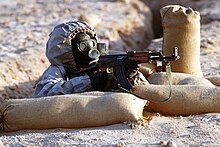
Syrian soldier aims a Type 56.
See also [edit]
- Type 63 assault rifle
- Type 81 assault burglarize
- Blazon 88 attack burglarize
- Type 58/68 assault burglarize, Northward Korean versions of the AK/AKM.
References [edit]
- ^ a b c d Brayley 2022, p. 160.
- ^ Small-scale Arms Survey (2012). "Surveying the Battlefield: Illicit Arms In Transitional islamic state of afghanistan, Republic of iraq, and Somalia". Pocket-size Artillery Survey 2022: Moving Targets. Cambridge Academy Press. p. 338. ISBN978-0-521-19714-four. Archived from the original (PDF) on 2022-08-31. Retrieved 2018-08-30 .
- ^ Minor Arms Survey (2005). "Sourcing the Tools of State of war: Small Arms Supplies to Conflict Zones". Modest Arms Survey 2005: Weapons at State of war. Oxford University Printing. p. 166. ISBN978-0-19-928085-8. Archived from the original (PDF) on 2022-08-thirty. Retrieved 2018-08-29 .
- ^ Small Arms Survey (2015). "Waning Cohesion: The Rise and Fall of the FDLR–FOCA" (PDF). Small Arms Survey 2022: weapons and the world (PDF). Cambridge Academy Printing. p. 201. Archived from the original (PDF) on 2022-01-28. Retrieved 2018-08-29 .
- ^ a b Iraq: Turning a blind centre: The arming of the Popular Mobilization Units (PDF) (Report). Amnesty International. 5 January 2022. p. 26. MDE 14/5386/2017. Archived (PDF) from the original on 13 March 2022. Retrieved 26 Oct 2022.
- ^ "Chinese Type 56 Milled AK". 23 September 2022.
- ^ globe.guns.ru on Type 56 Archived 2022-04-29 at the Wayback Car. Retrieved 29 April 2022.
- ^ "Why General Kalashnikov couldn't sell the AK in Bharat". India Today . Retrieved 2021-03-12 .
- ^ a b c Miller, David (2001). The Illustrated Directory of 20th Century Guns. Salamander Books Ltd. ISBN 1-84065-245-4.
- ^ "1956年式突击步枪". 枪炮世界.
- ^ a b Gordon Rottman (24 May 2022). The AK-47: Kalashnikov-series assault rifles. Osprey Publishing. pp. 47–49. ISBN978-one-84908-835-0. Archived from the original on 30 April 2022. Retrieved xvi July 2022.
- ^ Bobi Pirseyedi (one January 2000). The Pocket-size Arms Problem in Fundamental Asia: Features and Implications. United nations Publications UNIDIR. p. sixteen. ISBN978-92-9045-134-1. Archived from the original on 28 May 2022. Retrieved xvi July 2022.
- ^ Warlow, Tom (2004). Firearms, the Law, and Forensic Ballistic (2nd ed.). CRC Press. pp. 26–27, 47. ISBN978-0-203-56822-4. Archived from the original on 2022-04-28. Retrieved 2015-11-14 .
- ^ King, Wayne (January 19, 1989). "Weapon Used by Deranged Man Is Like shooting fish in a barrel to Buy". The New York Times . Retrieved 21 November 2022.
- ^ Ingram, Carl (May 25, 1989). "Governor Signs Assault Weapon Legislation". Los Angeles Times. p. 1. Archived from the original on 21 December 2022. Retrieved 21 November 2022.
- ^ Smith, Doug. "Chilling Portrait of Robber Emerges". Los Angeles Times. Archived from the original on 2022-04-01. Retrieved 2017-03-28 .
- ^ "Adoption of Type 56" (PDF) (in Finnish).
- ^ "详解中国首款QBZ56C型短突击步枪(组图)" (in Chinese). Sina.com. 2007-08-28. Archived from the original on 2007-11-12. Retrieved 2008-08-26 .
- ^ "中国新步枪名字实锤!为什么还有一个192型自动步枪?轻武专栏". NetEase News (in Chinese). 28 September 2022.
- ^ Norinco Archived 2008-12-10 at the Wayback Machine. Chicom47.net. Retrieved on 2022-05-20.
- ^ "Calorie-free Automobile Gun Blazon 56M (RPK)_Rifle_Weapon_Products_Jing an". Archived from the original on 2022-07-thirty. Retrieved 2018-07-30 .
- ^ "WipedOut". chicom47.com . Retrieved 2021-03-12 .
- ^ Brayley, Martin J (2013). Kalashnikov AK47 Series: The 7.62 ten 39mm Assault Rifle in Particular. Crowood. p. 32. ISBN978-1-84797-526-3.
- ^ a b c "TUL-1 light machine gun nevertheless in use in Vietnamese army". www.armyrecognition.com . Retrieved 2021-03-12 .
- ^ "Súng trung liên "made in Vietnam" uy lực cực mạnh khiến thế giới thán phục". Kienthuc (in Vietnamese). 19 June 2022.
- ^ "Khám phá súng trung liên TUL-1 "fabricated in Vietnam"". Báo điện tử Tiền Phong (in Vietnamese). 2022-03-06. Retrieved 2021-03-12 .
- ^ Bhatia, Michael Vinai; Sedra, Marking (May 2008). Small-scale Artillery Survey (ed.). Afghanistan, Arms and Disharmonize: Armed Groups, Disarmament and Security in a Post-War Club. Routledge. pp. 44, 65. ISBN978-0-415-45308-0. Archived from the original on 2022-09-01. Retrieved 2018-09-01 .
- ^ a b c d e f g Jones, Richard D. Jane's Infantry Weapons 2009/2010. Jane's Information Grouping; 35 edition (January 27, 2009). ISBN 978-0-7106-2869-five.
- ^ "Earth Infantry Weapons: Algeria". 2008. Archived from the original on 10 Oct 2022.
- ^ "Bangladeshi Soldiers Are Issued A Unique Assail Rifle". 1 March 2022. Archived from the original on xi June 2022. Retrieved 10 May 2022.
- ^ File:3rd Visitor, Beninese Ground forces sergeant demonstrates AK-47 disassembly at Bembèrèkè 2009-06-12.JPG
- ^ Savannah de Tessières (January 2022). At the Crossroads of Sahelian Conflicts: Insecurity, Terrorism, and Artillery Trafficking in Niger (PDF) (Report). Minor Arms Survey. p. 55. ISBN978-2-940548-48-iv. Archived from the original (PDF) on 2022-06-12. Retrieved 2018-06-05 .
- ^ File:Infantería de marina boliviana encima de lanchas inflables.jpg
- ^ "Bosnian soldier equipped with Blazon 56 assault rifle". 20 March 2022.
- ^ Small Arms Survey (2007). "Armed Violence in Burundi: Conflict and Post-Conflict Bujumbura" (PDF). The Minor Arms Survey 2007: Guns and the Metropolis. Cambridge Academy Press. p. 204. ISBN978-0-521-88039-8. Archived from the original on 2022-08-27. Retrieved 2018-08-29 .
- ^ Working Papers Archived 2022-07-04 at the Wayback Machine. Small Artillery Survey (2011-12-01). Retrieved on 2022-05-20.
- ^ McNab, Chris (2002). 20th Century Military Uniforms (2nd ed.). Kent: Grange Books. p. 38. ISBN0760730946.
- ^ Touchard, Laurent (17 December 2022). "Centrafrique : le Soudan a-t-il armé les ex-Séléka ?". Jeune Afrique (in French). Archived from the original on thirty January 2022. Retrieved 29 January 2022.
- ^ Small Arms Survey (2003). "Making the Deviation?: Weapon Collection and Pocket-size Arms Availability in the Republic of Congo". Minor Arms Survey 2003: Evolution Denied. Oxford University Printing. p. 263. ISBN0199251754. Archived from the original (PDF) on 2022-08-29. Retrieved 2018-08-29 .
- ^ File:Congolese Light Infantry Battalion preparation at Campsite Base of operations, Kisangani 2022-05-05 2.JPG
- ^ McNab 2002, p. 42.
- ^ "Vojničke puške – mup.hour". 16 March 2022. Archived from the original on xvi March 2022. Retrieved 10 May 2022.
{{cite web}}: CS1 maint: bot: original URL status unknown (link) - ^ File:2013 09 10 Belet Weyne Snapshots 3 E.jpg (9720302735).jpg
- ^ "ForumDefesa.com". Archived from the original on 8 October 2022. Retrieved 13 Nov 2022.
- ^ Mosquera, Talina. "FF.AA. analizan usar los AK-47 de China para entrenamientos". El Comercio. Archived from the original on 31 May 2022. Retrieved x May 2022.
- ^ "56-2式冲锋枪(原版)详解 – 铁血网". Archived from the original on 2022-10-xix. Retrieved 2014-06-xiv .
- ^ "散布在世界各个角落里的中国轻兵器!(图片) – 铁血网". Archived from the original on 2022-07-09. Retrieved 2014-06-14 .
- ^ http://traditional.fi/PDF/Adoptation_of_Type56_by_FDF.pdf[ bare URL PDF ]
- ^ File:A Gambian soldier fires a hammered pair, or two shots in rapid succession, during gainsay marksmanship training July 15, 2022, in Thies, Senegal, as role of do Western Accordance 2022 120715-K-XI134-1812.jpg
- ^ File:Iranian soldier at Republic of iraq-Iran border, Wasit Province 2008-09-xi.JPG
- ^ File:Ezidi Peshmerga soldiers at their base in the Sinjar Mountains, nether the command of Qasim Shesho 16.jpg
- ^ de Tessières, Savannah (April 2022). Enquête nationale sur les armes légères et de petit calibre en Côte d'Ivoire: les défis du contrôle des armes et de la lutte contre la violence armée avant la crise post-électorale (PDF) (Study). Special Report No. 14 (in French). UNDP, Committee Nationale de Lutte contre la Prolifération et la Circulation Illicite des Armes Légères et de Petit Calibre and Small Arms Survey. p. 97. Archived from the original (PDF) on 2022-x-09. Retrieved 2018-08-30 .
- ^ Pocket-size Arms Survey (2009). "Revealing Provenance: Weapons Tracing during and after Conflict". Small Arms Survey 2009: Shadows of War. Cambridge Academy Press. p. 112. ISBN978-0-521-88041-1. Archived from the original (PDF) on 2022-08-30. Retrieved 2018-08-30 .
- ^ Small Arms Survey 2009, p. 125.
- ^ Agius, Matthew (14 July 2022). "Personnel reveal shortcomings inside Maltese armed forces". Malta Today. Archived from the original on 22 Apr 2022. Retrieved 26 April 2022.
- ^ Scarlata, Paul (May 2022). "The military machine burglarize cartridges of Burma/Myanmar". Shotgun News. Archived from the original on 2022-xi-28. Retrieved 2018-eleven-27 .
- ^ "Legacies of War in the Company of Peace: Firearms in Nepal" (PDF). Nepal Event Cursory. Small-scale Arms Survey (ii): 5–seven. May 2022. Archived from the original (PDF) on 2022-07-08. Retrieved 2019-01-08 .
- ^ Jurado, Carlos Caballero (1990). Central American Wars 1959–89. Men-at-Arms 221. London: Osprey Publishing. p. 19. ISBN9780850459456.
- ^ File:Nigerien soldier Komadogou 2022.jpg
- ^ Rwanda Archived 2022-01-17 at the Wayback Machine.
- ^ "Tajikistan Arms Its Soldiers With Chinese Rifles". 21stcenturyasianarmsrace.com . Retrieved 12 January 2022.
- ^ "World Infantry Weapons: Sierra Leone". 2022. Archived from the original on 24 November 2022. [ self-published source ]
- ^ File:2014 02 21 SNA PASSOUT PARADE 08 (12694506064).jpg
- ^ Small Arms Survey (2014). "Weapons tracing in Sudan and South Sudan" (PDF). Pocket-size Arms Survey 2022: Women and guns (PDF). Cambridge University Press. p. 226. Archived from the original (PDF) on 2022-10-xiv. Retrieved 2018-08-29 .
- ^ "MAZ". Military Manufacture Corporation. Archived from the original on 2008-12-27. Retrieved 2009-02-08 .
- ^ "Syrie: les ISIS Hunters, ces soldats du régime de Damas formés par la Russie". France-Soir (in French). xxx May 2022. Archived from the original on 10 September 2022. Retrieved 10 Oct 2022.
- ^ a b Pocket-sized Arms Survey (2006). "Fuelling Fearfulness: The Lord'due south Resistance Ground forces and Small Arms". Modest Arms Survey 2006: Unfinished Business. Oxford University Press. p. 283. ISBN978-0-nineteen-929848-viii. Archived from the original (PDF) on 2022-08-xxx. Retrieved 2018-08-29 .
- ^ Gordon L. Rottman (2010). Regular army of the Commonwealth of Vietnam 1955–75. Vol. Men-at-Arms 458. Osprey Publishing. p. 18. ISBN9781849081818.
- ^ File:Yemeni soldiers from the 1st Armoured Division.JPG
- ^ Cullen, Tony; Drury, Ian; Bishop, Chris (1988). The Encyclopedia of World Armed services Weapons (1988 ed.). Greenville: Crescent Publications. pp. 196–197. ISBN978-0517653418.
External links [edit]
 | Wikimedia Commons has media related to Type 56. |
- Sino Defence
- Modern Firearms

Source: https://en.wikipedia.org/wiki/Type_56_assault_rifle
Posted by: marshallscon1994.blogspot.com
0 Response to "How To Make Clean A Sporter Ak-47"
Post a Comment